Reg Langlois’s memories of the 1950s in Jersey: meeting his future wife, the family silver, boats, a Vespa, their 1959 wedding and honeymoon, and learning the hard way in business.
Big turning point
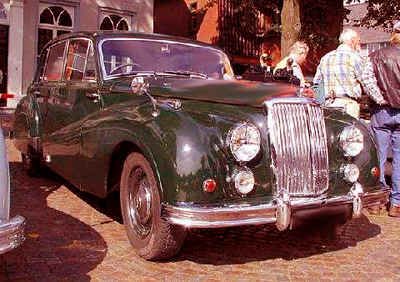
My life took a turn for the better when I met my future wife. At the time she was seventeen and still at college and I was eighteen. Luck seemed to be coming my way. Firstly, my wage for a sixty-five hour week had been increased to £4.10s.0d. and my father had lent me his Armstrong Siddeley car to take out my girlfriend. This was the car I had used to deliver vegetables to the shops but, by this time, he had bought another car for himself - an Armstrong Siddeley Sapphire similar to the one below.
The family silver
In 1954 our situation continued to improve when my father sold a further eight plots of land across the road for building, as well as The Brae. We moved across the field to Tabor Farm, which although not a patch on he Brae for quality, was more homely and had a good number of rooms, some of which were let to lodgers. These were artists whose agent, Billy Forest, placed with us whenever we had spare accommodation. On my twenty-first birthday in 1957 I was given another big present, a Remington electric shaver. My only previous big present had been a bicycle in 1949. Times were hard for us.
I wonder
When we were moving from The Brae to the farm house I came across a ships compass stored in a cupboard. My father told me that, during the occupation, a friend of his had given it to him as his wife did not want it in the house lest the Germans discovered it in their possession.. The story goes that my father's friend was down at the harbour collecting goods for delivery to stores around the island, when he had seen a fine German ship moored alongside the Albert Pier. As it was a high tide, the deck of the ship was level with the quay enabling him to see into the bridge. Never having seen such a ship, he thought he would take a closer look and jumped aboard. There would normally have been sailors about but, for some reason, this ship was unguarded. Having spent some time exploring, he decided it would be prudent to leave before any German sailors returned and discovered him but, as he headed for the quay he noticed that the ship's compass was only held down with clips. He released these and took the compass as a memento of his visit. It weighed over forty pounds. He wrapped it in sacking, placed it on the floor of the cab and drove off quickly about his business. I have since wondered whether it was really my father who had taken that compass but I can imagine the look on the faces of the Germans when they discovered its loss and I am sure someone received the blame. I am sure they would have been too embarrassed to advertise its loss in the Jersey Evening Post I still have that compass!
And talking about boats
I bought my first boat for a mere ten shillings from Mr. Arthur Newman in St. Brelade's Bay. Most people would have thought it better left in his yard but I felt it had potential with a little work done on it and I considered it was just what I needed. I collected it from the bay and took it home to commence its renovation. I preferred a bright colour instead of its black finish and tried to scrape this off but it had been painted with a preservative which had soaked into the timber. Someone from a boatyard in St. Aubin recommended that I use a sealer type of paint to prevent this preservative, which was pitch, from leaking through and he also suggested that I should caulk the gaps in the timbers before doing this. He explained that caulking meant forcing thick cord between the timber planks to prevent leaking. I thought I had just the right thing to achieve this as we had kegs of putty for use on the glasshouses and I could easily apply this, painting over the pitch with the chlorinated rubber sealant that we were also using at the time.
The weather was very warm when I started working on the boat. I removed the heavy tarpaulin and turned the boat upside down.. With a bit of effort the putty went into the tight gaps between the timbers and, as I continued, the gaps became a little wider and easier. I soon realised that the heat and exposure to the sun had dried the timbers, widening the gaps until they could take the thickness of a pencil but, at the same time, I realised that the putty I had put in earlier had all fallen out. I returned to the boatyard and asked them for caulking material but I did not tell them at that time that I had wasted my weekend puttying the boat instead of taking their advice. Caulking proved to be much easier than I had first thought and, by the time I had finished, I felt very experienced in it. I then commenced the painting. My boat was to be silver, which I considered very smart and quite different from any other boat in the harbour. What with the pitch undercoat and the rubberised top coat, it took two weeks to dry enough for me to walk on the floor without lifting the paint off with my feet though, admittedly, it took three top coats to cover the pitch undercoat.
I thought mine was a fine boat, eleven feet long with straight sides, a flat bottom and a two inch keel with brass rubbing strip. I had talked my father into giving me his Anzani two cylinder, four horsepower outboard motor which was in bits in a box under the work bench. Although I found there were pieces missing and parts cracked, I managed to weld it together and get it going. It was much more powerful than was normally needed for a boat of this size but mine weighed more than twice as much as others of the same size.
At that time, A.T., a good school friend of mine, obtained a brand new Stapley ten feet long wood clinker built varnished boat that was built in St Aubin, with an outboard motor. He and I each thought that our boats were the best around. He was still at college and I was starting my farming career but we were able to spend quite a lot of time together. If I was working at home on the tractor, he would jump up and sit on the wing of the tractor and we would chat for ages as friends do. He would even give me help me to muck out the pigs if I wanted to go out early on a Saturday night and, fifty plus years on, we are still good friends. In the summer months we would go down to St Aubin's harbour at six o'clock in the morning before school or work, take our boats off their respective moorings and cruise around to the beach at La Haule about half a mile away in convoy. We would scrub the boats even if they did not need it. A.T.'s boat always came up looking like new whereas mine, although clean, always came up looking like a block of sandpaper because of the paint I had used that had never really dried hard and attracted sand. However, sand sticking to the paint was an advantage, because whenever I touched or walked on the boat I did not get paint all over myself. A.T.'s two horse power outboard motor was very quiet, whereas mine sounded like a WW2 tank. My outboard motor had two horizontally opposed cylinders with spark plugs that faced in towards the boat. Had I lost concentration steering the boat, leaned backwards or turned the motor too sharply I would have received a nasty shock off the ends of the plugs.
Cockle
I had kept that boat for a year when someone offered me £2. 0s. 0d. for it. I think they were going to use it in their garden as a large flower tub. This was just after someone had offered me a fine little ten foot long sailing boat for £5.0s.0d. It was as wide as it was long and had a small sail so I modified the rigging. I added a flying spinnaker and a bowsprit. The little sailing boat I called Cockle was a lot lighter than my first one and was only about twenty years old. It was built of light weight marine ply wood on a light wooden frame had very high, straight sides, a rounded bow and a transom just large enough to take my four horse powered outboard. It looked very smart with the hull painted dark blue and everything else in a dark grey-brown varnish. It had just been painted when I bought it and I was told that the new patches on the bottom had been well fixed. It was time to take to the water, so early one morning I very proudly took the boat down to St. Aubin's harbour to launch it. A light breeze was blowing as I put it in the water for the first time since the modifications. It sat so well in the water, looking great, that I could not wait to set off. I raised the mainsail and nearly went over the side as the five foot long boom suddenly swung across the hull and hit me on the head. That was my first experience of sailing. Next I raised the flying spinnaker and, as that looked fine, I hoisted the steadying sail on the stern sprit. well. I then proceeded to cast off and, thankfully, as it was only six o'clock in the morning, there were few people about to see what happened next. I had no sooner released the rope from the harbour wall when Cockle took over like a fiend and, without warning, headed towards the harbour mouth at great speed. spinning like a top. I tried to stop her by dropping the sails, starting with the steadying sail, but that only made matters worse and she just buried her bow deeper in the water. Had she not had a deep hull, I would have been under water in seconds. As I hurriedly tried to take down the flying spinnaker, the mainsail began to rip, by which time I was already outside the harbour and heading towards the other side of the bay without paddles. In my enthusiasm I had forgotten to take them. I only kept her for a year, and, when I received an offer of £20.0s.0d. for her, I did not refuse it as my early enthusiasm for sailing had been dampened. I dare not tell you what happened when I tried to use a powerful outboard motor on her.
White Cloud
At eighteen I bought another boat, or I should say a hull, seventeen feet long. It was a power boat, home built to an American design to take a Ford V8 engine. All I wanted was a motor boat that was economical to use, this one would take up a lot of my time working on it. It was brand new and had been stored under cover since it was built. The light coloured varnish on the decks needed redoing, possibly because the wood had originally been used for a dance floor and the wax had not been completely cleaned off It had a hard chine hull with a deep keel.
With the £20. 0s. 0d. that I had for Cockle, I was able to upgrade to a boat boat that I could use in most weather conditions. It took over a year to get White Cloud into good going order. I bought a Ford 8 engine for £4. 0s. 0d. and a gear box for £1. 0s. 0d., with a Ford car steering wheel and column thrown in for the same price. I also bought a brass framed windscreen, I think it was from an old Morris car from Mr. Jeandron's motor business at Longueville. Soon after I had all the bits together and was about to install them, I was offered an vintage ten horse power Gains marine engine and gear box for nothing. I accepted this kind offer as I would have had to spend a long time adapting the Ford engine to marine use.
The Gains engine was built in the 1920's and had cylinder priming taps on its cylinder head. A friend of mine said that he would enjoy doing up this vintage engine as a project. He got it going on an engine bed, until the head gasket began leaking water. He took it apart and skimmed the head, made a new gasket and started it up again but, after going well for a few minutes, the impulse magneto gave up. After fixing that he had problems with the geared water pump, and thus matters continued for some time. Having put it all together, he found that it was overheating and suggested that it might be an idea for me to install the Ford 8 engine I had bought earlier, just to be on the safe side. He gave me all the help I needed in installing the Ford and the other bits and pieces. We made a few unusual modifications, such as cutting off the Ford gearbox, just leaving the clutch and clutch housing to give me the facility of having a neutral gear. I was then able to release the clutch and move forward very smoothly as if in a car. The steering column gear box was modified and we were able to cut a pulley into the steering shaft, running the steering cable through and around the hull to the rudder. The rudder was made from the base of one of the German galvanized posts that we had around the farm and it was welded to a short length of propeller shaft The fifteen gallon copper fuel tank had come from an old lorry that had seen better days and all the clocks on the dash board were from a Ford van. We used a simple push pull switch for the ignition and ran water through the exhaust system to cut the sound of the exhaust.
When White Cloud was freshly painted and varnished, I launched her on the beach at St Aubin. She floated well and, with her brilliant white hull and mirror like varnish, she looked beautiful. I was very proud as I went into the harbour to moor her up alongside the other boats. My girlfriend and I spent as much time as possible on our boat. It was now 'our' boat. As she was still at school and I was working on the farm, we had little free time but we took it out whenever we could. We had White Cloud for further five years.
On one occasion we met the Royal yacht Britannia, with Queen Elizabeth, the Queen Mother on board, as she rounded Noirmont Point. We were the nearest boat to the Britannia as it anchored in the bay and received a wave from the Queen Mother as she stood near the rail on deck. We had nearly missed reaching there in time for, as we set off, the anchor rope with the anchor attached had slipped off the highly polished deck when we hit a bit of rough water and had slowed us down. Had it caught on the bottom we could have turned over.
Later on in the evening of the Royal visit, we took seven members of the family across the bay to take a closer look at the Royal yacht. It was moored in St Aubin's Bay and there was not a single boat around as we approached. We were so close we could have touched her side but thought better of it as we might have been seen. We saw no one until we passed under the bow and anchor chain, when we waved to an officer looking down on us from the point of the bow. He did not return the wave and was obviously not a friendly type.
1957 I am now twenty one years old and still working for my father on the land at a mere £5. 10s. 0d. per week for sixty to seventy hours. During that summer, for the very first time I asked my father for a rise. He looked at me blankly and calmly said that, if he had more money he would give me some but that, as we were on the subject of pay, it might be better if I were to find another job or, better still, work on the land and also do part-time work to earn more money. I had never seen him like that before but then I had never before asked him for more pay in the five years I had worked for him for fear of what he might say. Life was hell for me after that conversation and nothing I did was right in my father's eyes. He would ask friends and acquaintances if they had any work for me.
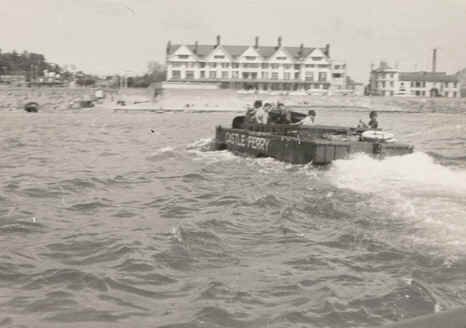
That October he was approached by Jack Bardin of the Duwks service that ran between West Park and Elizabeth Castle. Jack needed to maintain his vehicles but this must be done under cover and our stores were perfect for that work. They agreed a price and, at the same time, Jack was asked if he had work for me. He said that he did and that I would have to work a forty- eight hour week as he was so busy. At £9.0s.0d per week the pay would be almost double that I received from my father and, if I worked for him in the Summer, it would be £12.0s.0d.
My prospects had improved. I had a new job I enjoyed with less hours and I was able to spend more time with my girlfriend. I could work part time for my father to pay for my keep and earn a little pocked money at the same time.
Our Vespa
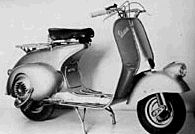
Of the changes at that time one was that, for economic reasons, I exchanged my German Stower jeep for a Vespa scooter. The jeep was very heavy on tyres and fuel and I must have kept Goldsmith's Garage on Victoria Avenue in business.
There were a lot of changes around that time, one of the changes was swapping my German jeep, the Stower for a Vespa scooter for economic reasons. The jeep was very heavy on tyres and fuel, I must have kept Goldsmith's Garage on Victoria avenue in business. While on the subject of Goldsmith's Garage and the jeep, I once bought a heavy duty, wooden cased battery from them. After a few months it needed recharging, so I put it on charge at the farm for a couple of days until I thought it was fully charged, when I gave it my normal test of flashing a piece of wire across the terminals. To my horror, the whole battery exploded, leaving nothing except small pieces up in the rafters. The worst thing was the noise which left my ears ringing for weeks afterwards. I was lucky not to have lost my sight and I never tried this again.
Thank you Jack
I began working for Jack Bardin the following week when he had brought the Duwks up to the farm for maintenance. We had to remove the engines, gearboxes and fuel tanks from all three of them, as well as the axles, drive shafts and wheels. Once everything had been removed, the first two vehicles had to be wire-brushed inside and out. Anything that appeared to be rusty had to be taken down to the bare metal with a hammer and chisel and repainted. Hammering inside the bodies of the Duwks was deafening but I grew accustomed to it. The third Duwks was new to the company and had recently been brought over to Jersey. I understood that it had been on standby duty for the Suez Canal crossing. It had been painted in sand-coloured camouflage.
When the Duwks first came to Jersey, Jack had the outer ribs and panels removed and this was to be the case with the last one. He always suspected that there would be rust inside the outer ribs and that eventually the panels would rust through. He was right for, as we began to cut away the panels, we saw the start of the rust. In those early days we only used hammer and chisels to cut off the ribs and panels. which was hard work and noisy. It took months to do all the work on such large vehicles for we were only two while Jack would be back at his workshop stripping down the six GMC engines and spare parts in preparation for the coming season. What I admired about Jack was that he practiced what he preached when it came to any engineering work and he was and is a master of engineering. He taught me the bare essentials of how an engine is assembled. If I had a problem he was always prepared to stop his work to show me what to do. His philosophy was 'It has gone wrong. We know we can fix it but why did it go wrong? Let us find out now'.
That goes for many things in life.
DUWK Driving
It was the beginning of March 1958 and all three Duwks were painted and ready to take down to St Aubin. The idea was that the Duwks would be towed along the road under their own steam on a pretend tow rope, as they were not taxed or insured to be driven on the road. Jack was in a hurry to get them across to Elizabeth Castle before the next tide. My father stood in the farm yard while Jack made his arrangements, thinking out loud how he would tow them down, when my father came up with the bright idea that I could take his elderly Armstrong Siddeley which was used to take the produce to the shops. My father's approval was enough and we set off very slowly along the road with me driving the car towing a long, thick rope with a Duwk attached. In my mirror I noticed that Jack was catching up with me and, to take up the slack in the tow rope, I would have to increase my speed. Instead of ten mph we were doing a steady twenty and I began to feel a little more confident that all was well until we reached Woodbine Corner, when I came to an abrupt halt in the centre of the road and waited for Jack's DUWK to slam into the back of me. He had accidentally driven on to the slack tow rope, stopping me in my tracks and having no time to brake. I remember looking in the mirror, watching the Duwk coming closer until all went dark. Thank goodness the Armstrong cars were built like tanks but, in a second, the Duwk had converted it from a four door saloon with a large boot to a two door with a flat platform at the back. Jack paid for the car to be straightened out and my father later said that it looked better then than it had before.
The remaining two Duwks were accompanied by a tractor and not towed. When all three were on the beach at La Haule we set off in line to West Park slipway. Jack had told us to go no faster than him and we did not but I would never have believed that vehicles the size and weight of the Duwks would have been capable of doing sixty miles per hour on that surface. We must have made quite a sight from the land as we jumped over the shallow gullies caused by the water running off the land. However, that was the first and last time that Jack ever permitted us to travel at that speed. Perhaps he felt guilty about the damaged car and this was to cheer me up. It did.
Within two days of delivering the Duwks to the workshop at Elizabeth Castle, we were ready to start driving. They were filled with fuel and all possible checks were completed. Jack was not going to allow his safety record to fall with breakdowns. Over the winter we had gone through every inch of them and were fairly confident that we would have a trouble-free Summer.
I was somewhat nervous at the prospect of carrying my first passengers as I had never been involved with groups of people before. Working on the farm I only had to deal with people on a one to one basis and I would now be responsible for twenty or so passengers.
Although the weather had been perfect during the Spring and early Summer, there were few visitors about and I had only to take a few castle maintenance workers and cafe staff to and fro. We had placed the boarding ramp in position near the slipway and had put up the signs advertising our service. Jack could tell that I was becoming a little jittery and told me not to worry about meeting the public. He had felt the same when he first started driving and he would accompany me for the first few days to give me support.
Jack gave Andre, the other driver and myself a last minute pep talk Firstly, he told us that the customer was always right and that we must treat them with respect. Secondly, we must not take more than twenty passengers over the land and no more than twelve on the water. 'I was thinking of only half that number' I told Jack. To which he replied 'Wait and see, my boy, you will be surprised.' Jack kept his word and did help me for the first trip. However, there was a build up of passengers wanting to go to the castle and he had to carry some of them on his Duwk. I had no time for nerves that day or after for, by its end, I had carried over three hundred passengers. Jack had cured me of my shyness and I never again thought of this as a boring job. By the season's end we had carried over thirty thousand passengers.
One of my little passengers
All daily maintenance, fuel top up, oil changes and complete washing down of the Duwks had to be done before we could set off from the castle each morning, which meant a very early start.. I frequently left home at five thirty in the morning with my newly acquired Vespa scooter and, if the tide was out, I was able to dross the three quarters of a mile of green, slimy concrete causeway to the castle. concrete causeway to the castle. Occasionally if I was a little late or a little early in my timing, the water might just be over-lapping the causeway by a few inches but, if the tide was rising, there was no turning back. I was committed and had to press on through the shallow water at speed. It would be some forty years before someone came up with the idea of a water scooter with wheels. If the tide was high and it was impossible to get out to the castle in time for work, we would go down to St Helier harbour and take my boat, White Cloud, which was moored there for the Summer season. White Cloud, with its eight horse power engine, ran beautifully for the whole season with one exception. She was full of engineers when we ran out of fuel just ahead of a ship with twelve hundred passengers. It was headed for the harbour mouth and could not avoid us so we had to get out its way in a hurry. We pulled up some floor boards and began to paddle furiously. As the ship sailed past the passengers cheered and waved to us and it gave us a blast on the horn. I worked for Jack during the autumn months until my father wanted help on the farm. As Jack could only support one person with work over the Winter, I agreed to help him, but my wage was poor, so he allowed me to do some outside work for other growers and, at the same time, I had rented some land for growing flowers. I bought a Ferguson tractor with implements from my father and was able to undertake rotovating and ploughing contracts for other growers. In the early days my ploughing customers would pay for the fuel I used.
My matrimonial future
We became engaged in 1958, having known each other for five years. My fiancée was secretary to a bank manager and, for the first time in my life, I had managed to save some money during the Summer.. My life had become more settled with work for my father to pay for my keep and tractor contracting for others. We were able to rent for six years a small one bedroom bungalow and land for £5. 0s. 0d.per week in St Brelade.
The land was in a steep valley and only a quarter of it could be worked with the tractor while the remainder had to be worked with either a small walk-behind-tractor or by hand with a spade.
1959. We were married
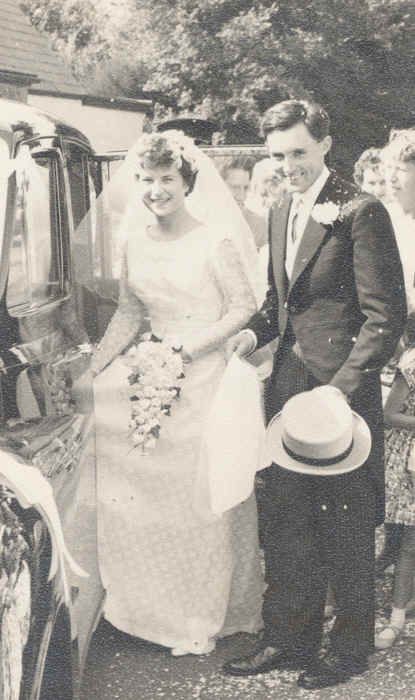
After six years we felt sure we must be right for each other and we were married in September at St. Ouen's Parish Church on a beautiful, sunny day surrounded by our families and friends. Our reception at the Grand Hotel cost as much as twelve shillings and sixpence per head for the food and as many drinks as we wanted. In those days people drank spirits rather than wine and those who saw us off at the airport had driven there having consumed whisky, gin, martinis, etc., as well as the traditional glass of champagne. The roads were not very busy and, other than when there was an accident, the police did not concern themselves. Needless to say, it was a very happy occasion and the only upset for me was having to wear morning dress. In those days I hated dressing up but I think Moss Bross would have been impressed had they seen me the day before parading their top hat while driving the tractor.
Honeymoon
Badgers Holt
Oxford
It was my first time away from Jersey in eight years and it was to be the last time for another eight. We went to London by air on a BEA Dakota and hired an Austin A40 car from a car hire firm in Berkeley Square. Driving out of London was a big headache for me as there was much more traffic than in Jersey. At home I was confident but, behind the wheel of a new car, surrounded by double decker buses I found it impossible to see where I was going. Seeing a gap in the stream of buses I pulled over to the left and stopped. Within seconds a policeman's face appeared at the window. He asked what was wrong and I told him I was lost but that we were trying to head for Oxford. He assured me we were on the right road, put up his hand to stop the traffic and waved us on. I breathed a sigh of relief.
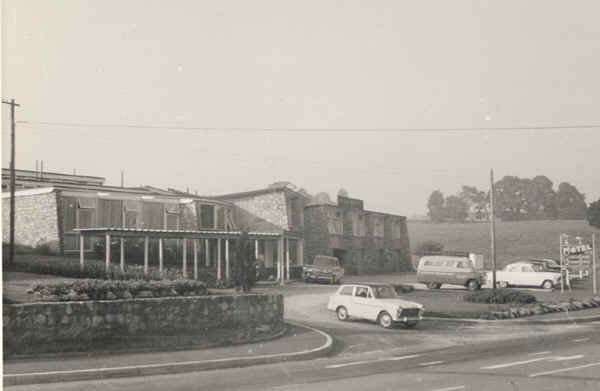
We toured South-West England, driving from Oxford to Stratford on Avon, where we spent the next night in a room with no key. The receptionist told us that they had no keys for the rooms as the American tourists took them as souvenirs. The following day we visited the beautiful city of Bath where we stayed in an annex to one of the large hotels in one of the crescents overlooking a park. The elderly lady in charge of the annex looked exactly like Margaret Rutherford and could not do enough for us when she discovered we were newly married. She even went as far as moving one of her guests to another room so that we could have the best one in her hotel. She really was a lovely lady. The following day we headed for the South coast and stayed over night at a new motel on the newly constructed Exeter bypass. It had only just opened and it was the second one built in Britain.
Newly built Exeter by-pass Motel
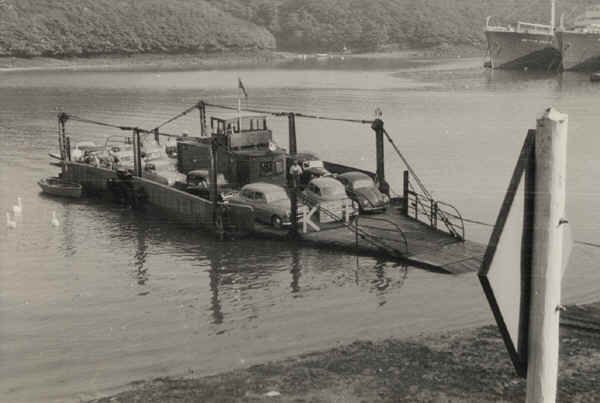
We crossed the River Fal on the King Harry ferry.
The following day we drove down through Dartmoor in Devon to a picturesque little seaside town called Fowey in Cornwell. We stayed the night in a guest house. It had very unusual floor covering in the bedroom. The owners had planed and varnished the wooden floor and all around the room they had laid a frame of black lino on which that they had created a very intricate design with paint. I asked them how they did it and they said that they had just tipped the paint directly from the tin. They were proud to show me other rooms, even the stairs, where they had done exactly the same, the only difference being in the colour of the paint applied to the same black lino. Every wall of their guest house was decorated with murals depicting local scenes, all painted by the landlord who was quite an artist.
One evening the refrigerator broke down and they were taking it apart to try to have it working for the next day. I volunteered to help and, between us, we eventually started it up again. After a cup of tea and a long chat, I went up to bed at about 4.00 a.m. My wife was not amused though, in time, she grew used to my nocturnal habits
Back to reality, with £5. 0s. 0d
Back in Jersey in our own home, called the Bungalow, Quaisne Common, St Brelade. Although only twenty feet by twenty with four small rooms, to us our bungalow was a mansion and it was to be our home for the next six years. It faced South in a secluded valley overlooking Ouaisne Common and the sea and had with it eight vergees of land on which I intended to grow marketable crops. We had one small, wooden shed which might have taken a small car had the doors been left open. We could not be overlooked so tractors, ploughs and vehicles were left in the open covered with corrugated iron sheeting to protect them from the elements. Massive pine trees shaded us in Summer and protected us from the south-westerly gales in the Autumn and Winter. The land was very sandy, having formed part of the Ouaisne dunes and our access to the bungalow was on a track across the common - a distance of some 400 yards from the main hill. In the Winter, I had to mark our route home with long bamboo canes as the common was regularly flooded. On one occasion I had to rescue the postman who had drifted off the track and was stuck in deep water. He was in too deep for a rope to be tied around his bumper so, standing on my tractor seat, I lassoed the whole van to tow him out.
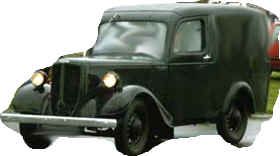
As we had the Armstrong Siddeley car my father had given me, I sold my Vespa. The car was in a poor state of repair, with the gear box trying to part company with the engine and the front mudguards and some of the bodywork starting to break away. I no longer had access to the farm petrol pump and the car was very expensive to run so we soon decided to give it up and buy something not only more economical to run, but able to carry light loads of produce for delivery in the Island. We bought an elderly Jowette Bradford van with a spare engine and gearbox for £10. 0s. 0d. To say the least, it was a bit rough and had its bodywork hanging off, but it was just what I needed. I cut the wrecked metal body off just behind the cab and added a flat platform on to the chassis. The timber for the platform was made of two heavy doors and I reinforced the edges with metal strips from an old bedstead.
The Jowette 8 hp engine was designed in 1906.
The van had a few nasty little quirks, possibly because of its age. The throttle cable jammed from time to time, although I greased it regularly, and it made the engine run fast at the most inconvenient moments. The hand and foot breaks pulled the van up very well when the roads were dry but, when they were wet, they turned the van into a spinning top. The gearbox was quite unusual with a dancing gear lever that moved about like a butterfly when you tried to change gear, darting out of the way and sometimes coming right out of the top of the gear box. Driving at night it was almost impossible to push it back back into the gearbox but the worst was when all three things happened at the same time.
We did very well with the little van. It carried all our produce from our small holding to the local shops and hotels, as well as the loads of logs that we had cut for sale to the local residents. With tractor contracting and lawn mowing with my new mower, I was working very hard.
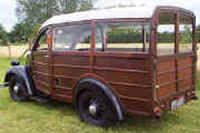
A little later, I upgraded to a Ford ten hp van with wooden bodywork, which was pretty sluggish and discharged black smoke. It left a plume of smoke wherever we went. This was so embarrassing, that I bought another engine and, as I was fitting it, I heard on the radio that President Kennedy had been assassinated.
My Ford was like the one below
My next means of transport, a Peugeot 202
I rented more land to grow narcissi and iris for cutting for export and, at the same time, I grew plants for sale to our local shops. I still recall potting one thousand five hundred cacti to sell. I had bought a job lot from a grower who was giving up growing and who had kept them as a hobby in his glasshouse. I carefully took off dozens of shoots and planted them in clay pots, some being at least thirty inches tall and others as small as my finger nail. I used a good potting mix with a pebble topping and, to me, they looked pretty good. These all went into my homemade cold frame with old doors for its surrounds and glass frames from old greenhouses.
I spent weeks working on the cacti, opening and closing the frames watering the pots and weeding them. When they were ready I delivered them to a local supermarket, who promised to take all I could grow, as long as I did not offer them to other shops. They set up a good display and I gave them two hundred to start with as they thought that they could sell a lot. The arrangement had been sale or return but, as they only sold five pots in the first two weeks and another three the following week, they asked me to collect the remainder. On my way home I called at other smaller shops offering them my cacti at a heavy discount to take them off my hands but I must have been dreaming to think that, with Christmas coming, I would be able to be rid of them. Not a single one wanted them so I decided to keep them until late Spring in the hope of selling them then but, by the end of January that year, I had lost them all in one of the worst freeze ups we had ever had, despite the fact that they had been under glass with sacking insulation over the top. After all the time, effort and care I had put into these cacti, this disaster proved to be a learning curve for me.
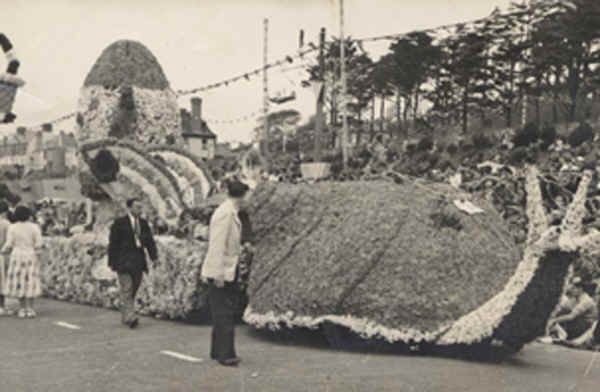
As flower growing was profitable at that time and as I wanted to expand my business, I looked around for a glasshouse to rent to grow iris for export, with a second crop such as lettuce, tomatoes, beans or potatoes for the local trade. My father suggested that I might take over his large glasshouse, doing some work for him on the farm in payment. This arrangement seemed fair but the glasshouse, having been used for tomato growing, was now full of old farming equipment that had been stored in the main shed but was now dumped there as the shed had been rented out as storage to different businesses. St Brelade Battle of Flower entry, built in the shed at Tabor Farm
One of the first businesses to rent space was Jack Bardin with his Duwks then Aviation Jersey from Beaumont with crates of aircraft engines and spare parts. For a short time during one summer, the St Brelade Battle of Flowers float was built at the farm, then Tantivy Coaches used it to brush paint their coaches to a fine, enameled finish. After them came Normans store, who had a contract for supplying the airport with bagged cement, of which they stored several hundred tons in this shed. This took weeks to clean up after they left and years later cement dust still drifted down from the rafters. Tucked away in a corner of the farm buildings, away from all this dust, was a cabinet maker and joinery business, making good quality fitted furniture for hotels and homes.
Again I had to learn the hard way
In whatever space was left in the glasshouse after moving all the junk to one side, we planted lettuce plants and iris bulbs during the autumn, when the soil was cold and damp. We knelt on planks of wood to plant to avoid compacting the soil after we had forked it up.
The glasshouse was situated in the bottom of a small valley and, as there was a row of trees to the east of it and a large shed to the south, it had very little sunshine for a good part of the year. Although part of the valley had been filled in with rubble and heavy clay like soil before the glasshouse was built, the soil in the it was water logged. This was not so noticeable in the Summer but in the Winter it remained wet and the lower part of the glasshouse was often flooded so that, as there was no heating, many iris corms and lettuce plants rotted..
My father had built the glasshouse principally for growing tomatoes in the late Spring and early Summer and had not used it when damp. I had been using it for two years and had added loads of compost and fresh soil to try to drain it, when my father said I was to paint the internal steelwork with a special chlorinated paint during the Winter months while I was not using it. We never considered that this would effect any future planting but we were wrong. In the Spring, I filled the house with tomato plants, took great care of them and prepared the wires for them to climb. They were growing well and we had anticipated a good harvest when we had a very hot day.
As usual, I went up to the farm in the early morning to open the ventilators in the roof when I smelt what I can only describe as a gas of some kind. I thought it was from the new compost so I did not worry too much.
However, that evening when I returned to close the vents, the smell was still there so I left the vents open all night. The next day was even hotter and the smell was even stronger. The tomatoes were showing signs of wilting. I asked the opinion of a friend who immediately asked if I had painted the glasshouse lately. I said that I had painted it with chlorinated paint some five or six months earlier and was told that, as the temperature was now much higher, the gas was only now coming out of the paint. The plants had been gassed but, strangely, although I had lost the top of each plant, the bottom trusses did very well. That was the last occasion that the glasshouse was used for crops. The following Winter, Falles Hire Cars filled it with hire cars for storage, barring one small corner which later became a large amenity block for the campers' use.
Our income was improving and we were not keeping all our eggs in one basket as before. We had a successful garden contracting business together with the smallholding, where we grew flowers for export. The tractor work was also going well and, in a very short time, I realised that the garden contracting was needing my full attention so I had to give up the extra land that I had rented for £10.0s.0d a vergee. I just kept the land around the bungalow for growing bedding plants around the bungalow for growing bedding plants.
Overnight success
In a very short time the tractor contracting business was also overtaken by what proved to be the more lucrative business of garden contracting. This involved anything from designing and landscaping to minor demolition on building sites in preparation for garden layouts. I frequently employed as many as ten people at a time and took on everything I could. One of the first major jobs was to clear and clean up the site of Jersey's first multi-storey housing estate at the end of Green Street. We had to clear loads of heavy-duty barbed wire left by the Germans during the occupation and the builders had not helped by having bulldozed the rubble and barbed wire together onto the area we were to landscape. Once the buildings were built, it was impossible to access the site with any kind of transport so that everything had to be moved manually for some thirty yards. We also had to remove from the site a large block of reinforced concrete foundation that had been used as a base for a pylon and this was five feet wide and weighed at least two tons. As it would have been impossible to break it up into smaller pieces without the use of a heavy-duty jackhammer, that we could ill afford, we decided to bury it in situ.. We dug a large hole about eight feet deep adjacent to the concrete, though we were a little apprehensive that it might roll in by itself before we were ready for it. As we were working on a steep slope it might well have missed the hole and rolled down the bank to crash into the main tower block.
A learning curve
I jumped at the chance of having the contract for cutting down and clearing away three hundred and fifty trees with their roots from a well known Jersey manor. The owner wanted his trees thinned out and a large area put down to grass once the trees and roots had been removed. I gave him a price for the job which he accepted without hesitation. I was later to find out that his lowest quotation had been three times higher than mine.
In addition to the original contract, we were asked to fell other trees around the manor., two of which remain in my memory as a nightmare. One of them, a Scots pine, with a trunk fifty feet high and a diameter of four feet, had to be cut down to five feet from the ground so that it would be level with the top of some very expensive metal fencing, part of which was embedded in the trunk. As this would have been impossible to remove, I decided to take it down in one piece but it would have to be cut at the right angle so that, when the trunk came down, it would kick out and away from the fence. This problem was compounded by the fact that the tree had to fall between two buildings.
That was a near miss
However, the other tree was an even greater problem for me. It was one hundred and twenty feet tall but had died and the owner wanted it down. It had towered over the parish for many years and, due to old age, it had lost all its branches and was completely shrouded in ivy. This enabled me to climb up some sixty feet to secure a rope which would be used to pull the tree away from the rhododendron shrubs beneath. I then tied the other end of the rope to my little Land Rover and began to cut the trunk, which was about thirty inches thick. I made a very large 'v' cut so that the tree would only fall in the direction of the Land Rover and then it was the turn of my assistant to cut the far side of the trunk so that the vehicle could take the strain. Hardly had I placed any strain on the rope when it went slack and I thought it had come away. There was a sound like thunder and the earth shook as the tree came down, missing the Land Rover by inches. The top twenty feet of it had broken off and bounced ahead of me.
Still learning
In all weathers we had worked on that job, the grassed area was growing well and had had its first cut. I could now send my account to the customer as we never asked for payment before completion. I was paid within two months but with a note advising me that, as the job had not been completed within the stipulated time, I would not be receiving the full amount. Altogether the work had taken five months, three weeks longer than agreed, as I had not taken into account the very wet conditions we were to encounter when we had to sow the grass area - nor did the customer. He withheld more money than I would have made in profit with eight men working for me as well as the hire of a JCB and two lorries to remove and clear the tree roots. Luckily this had not been my only contract for I had other work in the Island, including that for the States Housing Department cutting the grass around their estates. Despite competition from the Hamon family and Joe Bredonchel of Star Gardens, we had more than enough work to keep us busy. We would undertake basic landscaping of gardens from scratch and could do this easily and quickly, keeping costs down for the customer.
Go cart track at Belle Vue and the golf driving range at La Mielle at St Ouen
This was one of our most varied and interesting projects, starting with sixteen launching pads on a concrete base for the golf range at La Mielle in St Ouen and re erecting chain link fencing around the driving end.
Up at the go-cart track we excavated an area of one hundred and fifty feet long and one hundred feet wide for a boating lake. Once it had been dug, we had to lay a large sheet of butyl rubber matting over the excavation. Problem one was that the sheet was too short and had to be extended by something like thirty-five feet. The manufacturers had made a mistake in their calculations and had to send a man over to rectify this mistake by adding more material and joining it together with a special hot iron. The second mistake was ours and was made when we installed the large sheet and began to fill it in with clean sand, as we had been instructed to do by our clients. The idea was that, by covering the bottom of the lake with five inches deep of sand, it would be protected from damage by the boats. On the first day, when we had laid about twenty tons of sand with the help of five or six men, we felt as if we were going to be ahead of schedule and that, if all went well the next day, we would only need a further thirty tons of sand topped up with water and we would be at the end of that phase. However, when we arrived at the go-cart track to begin work, we found to our amazement that every grain of sand had disappeared from the bottom of the lake.
There had been very little wind the day before while we had been carting the sand so we had assumed it would still be there the next day but, during the night, the wind had risen and had blown the sand up the slopes and away. We then decided to wet the sand as we carted it and, although we too became very wet, it did the trick. Before excavating the hole for the lake, we had cut and removed all the turf for further use on the banks. Some of these were as much as nine feet high and fifteen thousand square feet of the turfs had to be laid on sand. Most of the banking was steep, in places as much as forty-five degrees and, as the Summer holiday season approached, our clients wanted the work to be completed, and it was with the exception that the turfs had to be continually watered.
We were about to leave when they asked us to do some extra work which involved widening the go-cart track on the corners and banking them up. I wanted to give the corners a Brooklyn type banking on them to add to the thrill of carting, but the clients said that I was to go by the plans that some racing association had given them. The plans looked very boring but the clients were paying so we did as instructed. We were then asked to re-erect all the fencing around the perimeter of the stadium, seven hundred feet of which was chain link eight feet high and, with security in mind, we attached barbed wire along the top and bottom of it. Two hundred and fifty feet of wooden fencing was erected along the most exposed area of the stadium as the oak posts used previously had broken off at ground level due to strong winds.
We also laid a railway line at Belle Vue to take the client's mini passenger train and carriages. The railway took a route through a landscaped area and along the top of the banking overlooking the boating lake. When this too was completed, we were also asked to build a go-cart track for juniors.
The bomb
That story could have had a different ending had I detonated the incendiary bomb that I had hooked out of the bottom of the excavation. I had been using a scraper blade on the back of my tractor to level the sandy bottom of the lake, when one of my men picked up a lump of rusty old iron and was about to throw it to one side when someone called out that it was a bomb. He dropped it on the spot about five yards behind me and ran away as fast as he could. I called the police to ask their advice as to what I should do with it. They told me to stay nearby and that they would collect it with their bomb disposal officer. They soon arrived and, picking it up very carefully, handed it to the man sitting in the back of the car, placing it on his lap. In all the excitement I had not noticed that that man was a school friend and neighbour of mine called Tony. Both he and the bomb were taken down to St. Ouen's Bay where he was able to blow it up safely.
Working on a large property in Park Estate, St Brelade.
One of the jobs we were asked to do.
We were asked by the owner to fell a large oak tree as the builder had realised that he would not be able to build the top floor and the roof of his house extension as it was in the way. The builder had reached a height of about eight feet with lightweight blocks and the idea was that we should wait until his men had finished for the day before we began to cut the tree down. felling the tree The block layers placed boards above the freshly built walls for us to walk on. Thankfully, the mortar they had used was of the quick drying type or, had we knocked a wall down, the rest would have followed like a pack of cards.
Another job was to prepare the ground for planting a rain forest of three hundred rhododendron bushes in a small valley on the property. First of all we had to spread over one hundred loads of soil that had been delivered to the garden, mostly by hand as we were not able to use machinery in such a steep valley. We then opened up two hundred bales of Irish peat and tipped them into a fish pond to soak for a few days before we could use them. The rhododendron bushes had been brought over to the island in two large freight containers and, because of their size, they had to be laid on the floor. Some of them were over ten feet tall and their roots were wrapped in wire and sacking. Many took four men to carry them onto the site. The owner had brought a gardening specialist over for one day from a nursery in England to show us where he had planned they should be planted. I do not know how we were expected to plant all the three hundred bushes in one day without a mechanical digger. I think that we did well in finishing that work in four days. We had to dig holes for planting three and four feet in diameter and three feet deep by hand. While we were planting, a builder with a large gang of men was building a circular tower up against a high granite wall nearby. The tower was fifteen feet and eighteen feet high using granite stones The wall of the tower was about two feet thick and the builder and his men had made up a lot of it in the first day. As they built, they filled it in with soil so that they could continue the work from the inside. They were confident of finishing it the following day and were using a dumper truck to tip the infill over the wall, then about eleven feet high, to speed up the work and make them more profit. The soil and granite stones must have weighed over eighty tons. Arriving a few minutes after the builder the next day we found him ranting and raving as the whole tower had come down in a heap of concrete, stones and soil. It had also buried at least a dozen of our plants.
His neighbour number one I was asked to follow the client through the master bedroom with a step ladder and chain saw, when I noticed that his very attractive wife was in bed. He said to me: Dont mind her, she is getting over a cold. I coughed and said something like Good morning I later thought what a silly thing to say because it was mid afternoon. We went through large French windows onto the balcony to be faced with a mass of branches obstructing the view of the bay from the bedroom from trees belonging to the client's neighbour. The client explained that he had asked the neighbour if he could cut back a few branches, but he did not explain at the time that he had been refused. Come to think about it now, it was like a game of hide and seek. I was at the top of my very high steps leaning over the balcony, with one foot on the steps and the other on the trees and the client standing with his full weight on the bottom rung. He was taking all the branches that I cut and throwing them behind him under a large over hang of the roof when, suddenly, he shouted Get down! The neighbours are back. He dived under the over hang of the roof onto the branches to compact them down and I followed him doing the same. I did not ever remember walking down the steps and think that I must have jumped from the top in all the excitement He did explain to me up on the roof, as hid from the neighbour, that he had been told some time before that he was not to touch the trees. He said that he thought they would not mind if he cut a few branches, but it was more than a few. In fact, it was more than a lorry load that we had up on the balcony. In all his haste he had even thrown some branches through the French windows into the bedroom, blocking our way in.
His neighbour number two Neighbour number two got upset when he found out that I, under my clients instruction, had cut out the top half of a huge oak tree so that he could have a better view of the bay from his home. I had been led to believe that my clients boundary was beyond the tree and that it belonged to him. All ended well when my client promised never to do it again.
His neighbour number three We planted a twenty feet tall tree to screen the neighbour from noticing the large two-floor extension that was being built in front of his house. The neighbour was abroad for six months and when he returned he was surprised to see that a tree had grown so well in his absence and a little annoyed to notice that it had cut away his view of the bay and it was some time before he noticed the extension. We planted the tree in fresh soil and surrounded its root with three forty gallon clean oil barrels with their lids left on so that we could cover them over out of sight. We made holes in their sides facing the root and filled them with water. That kept the roots moist all the time. That is why the tree grew so well.
Automatic garage doors I had a call from my client suggesting that my staff had been tampering with his newly installed garage doors and left them open and would I make sure that they did not touch them again. I asked all the staff if they had been along to Park Estate and they told me that they had not. One told me that, when he had been working near the garages, he had been surprised when the doors opened fully and closed again. He thought that someone was fooling around at the house, trying to surprise him, so he did not think any more about the incident until I spoke to him. A few days later I had a call from my client apologizing for thinking that we had touched his garage doors. He had just found out from the installer of the doors that they had been having trouble with the remote signal. It was the same frequency as that being used by aircraft flying overhead and, when they used their radio, it would also open the garage doors. Christmas day.
Christmas was like any other day while I was building up my gardening business. As an example, I had a call from my client at Park Estate asking me to go around to his house to cut a few logs for him as he was having a friend around for lunch. It was cold and raining when I went along to cut the logs in the garden. I cut enough to last a week or so and I took them to the house. The client said come on in and just put them down there and while you are here will you cut a few more enough for the next month. No mention of Christmas. I returned home at 2pm. Christmas or not, I still charged him five shillings an hour, That is twenty-five pence nowadays.
Another interesting client
I learnt a lot from my client from the Middle East. He was an entrepreneur, in finance, retail and building construction. I was interested in his building as he gave us a great deal of work in the Island for a few years. He built large houses, terraced houses, town houses and country houses and, when one was completed, he would call us in to clean up the sites and make the surrounding areas presentable so that they could be offered for sale. Fortunately for me the builders he employed always left the sites in a mess, with timber buried under the ground and large pieces of concrete where their cement mixers had stood. I have seen as much as a twelve inch depth of concrete spread over twenty feet that had to be removed before we could begin to form a garden. Some sites gave us a great deal of work and we were lucky in that the client more or less gave us a free hand to do what had to be done. We would do just enough landscaping to make the house attractive, terracing some of the gardens and, in some cases, laying turf where the soil conditions were wrong to sow lawns.
On one occasion we were asked to cut down a hawthorn hedge that was screening four newly built luxury houses from seeing the beautiful bay of St Aubin. The hedge was very old and had never been trimmed. It was at least fifteen feet high and over ten feet wide at the base and as far as I remember it was over two hundred feet long. I had moved onto the site with my men and had begun to cut down the hedge, when my client turned up and told us to cut it down to ground level to give the new owners a better view. He reminded us that we were not to let any branches fall onto the adjacent land as he did not want to upset his neighbour. The hedge was on the top of a fifteen feet high bank and, had we dropped anything over, we would have to had to go a long way around to retrieve it. My client said that he wanted the work to be completed by lunch time as he had someone coming around to view. In the first hour we had cut and cleared away half the hedge, when we heard a loud shout from a very angry looking gentleman standing on the field down below. He was calling out to us something about "calling the police" and that we had no right on his land. We stopped working and called my client to have a chat with the man below. They had a very short conversation and my client turned to me saying that there was a misunderstanding and we were to get on with our work. We continued for a further half an hour and had managed to cut down a lot more of the hedge, when we had to stop again. The gentleman from the field next door arrived with his lawyer and, at the same time, my client's lawyer arrived. They had a noisy meeting near us and began to search the undergrowth, my client and the lawyers in their pinstripes and the farmer in his working clothes, all looking for boundary stones. They found them! They were on my clients side of the hedge and the misunderstanding was my client's. The hedge was down and the client sold the houses quickly because of the view.
Exciting ..... no!
I do not know whether it was our efficiency (ha ha) or just value for money that inspired our middle eastern client to give us more work but he gave us a variety of jobs, some of which was not exactly garden contracting. For example, we had to fill a trench with ready-mixed concrete to make the foundations for a retaining wall on a housing development in St. Saviour's Road. In the early sixties it was unheard of in Jersey to use a pump to place concrete in this way. The long trench had been prepared for us and reinforcing steel rods had been laid in position with the finished levels using two by two inch wooden posts with two by four inch beams on them for us to work from. The builder had to go down as far as eleven feet through the soil to reach rock bottom. The trench we filled with concrete was only four feet wide and five to six feet deep, but the trench above was cut on a slope making a large v shape.
As we waited for the ready-mix trucks to unload, we realised that the slope on the sides of the trench had been cut far too wide and the trucks would not be able to get close enough to it. Instead of the drivers setting the outlet shute at an angle to discharge the concrete slowly into the trench, they had to raise it almost at right angles to shoot it further out from them. It was messy work and we were coated from head to foot in cement as we worked under a concrete fall spreading the concrete along the trench, ramming it into all the nooks and crannies between the steel rods. Worse still, the builder's labourers began tossing stones and bits of broken blocks from the top of the trench onto the fresh concrete below, splashing us even more. Mixing the rock and blocks with the concrete saved the builder using so much ready-mix. It was a relief when we had finished as the concrete was beginning to dry on our clothes. We had spread sixteen loads in three hours but we had taken a chance doing this work as it was dangerous and we had no hard hats. Had we fallen off the two by four inch wooden beam we would have sunk into five feet of liquid concrete!